
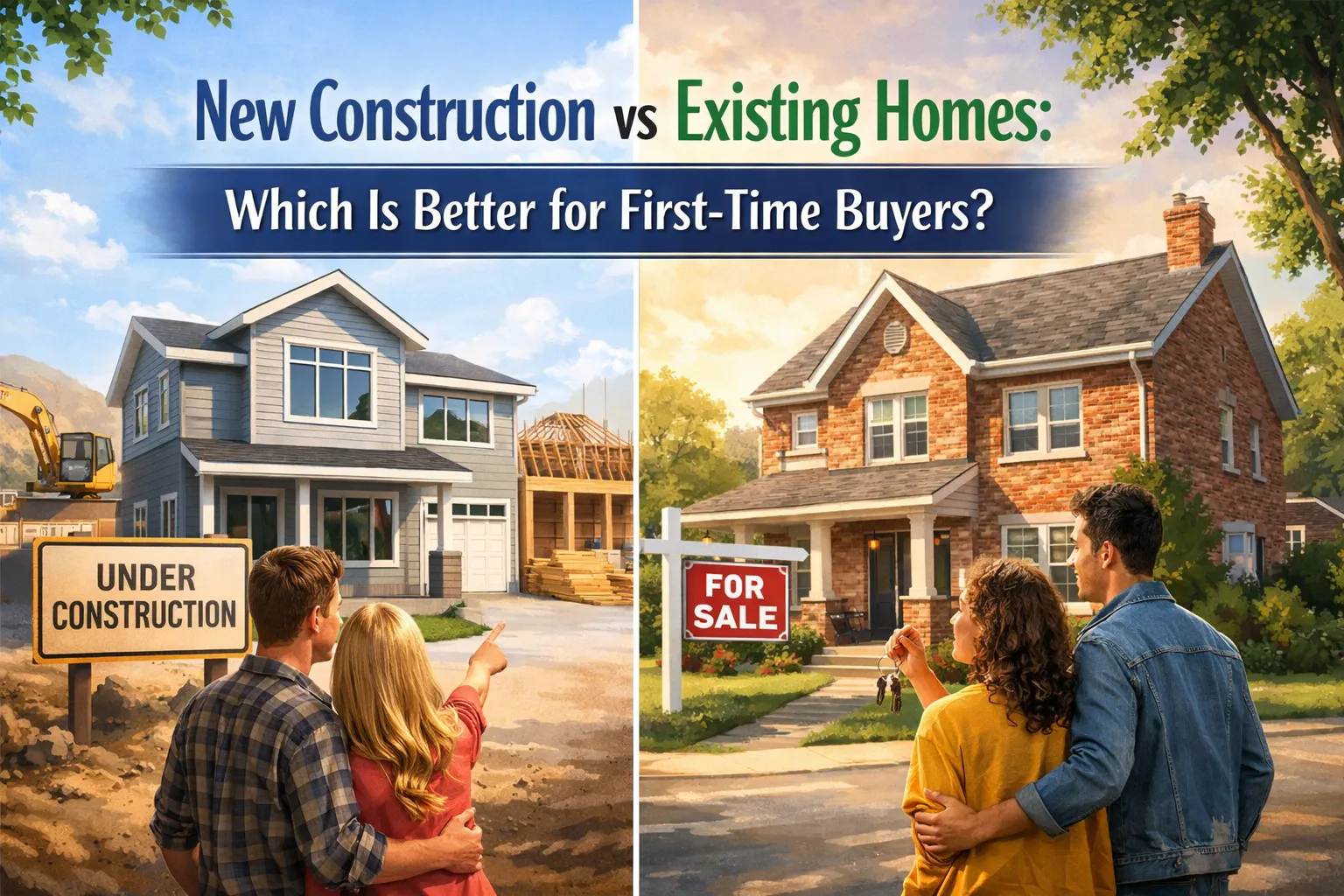
Buying your first home is equal parts thrilling and terrifying. You’re not just picking walls and a roof—you’re choosing between a brand-new house that’s never been lived in and an existing home that already has history, neighbors, and (sometimes) quirks.
The debate over new construction vs existing homes is especially intense for first-time buyers right now. Mortgage rates are still above 6.5%, inventory remains painfully low in most metros, and builder incentives are swinging wildly month to month. So which path actually makes more sense in 2025?
Let’s break it down with current data, real-world math, and the questions I ask every first-time buyer who sits across from my desk.
The Price Gap Has Narrowed (But Not Disappeared)
For years, the rule of thumb was simple: new construction costs 20–30% more than an equivalent existing home. That gap has shrunk dramatically in many markets.
According to the U.S. Census Bureau and NAR data through Q3 2024:
- Median price of a new home sold: $417,700
- Median price of an existing home sold: $392,200
That’s only a 6.5% difference—the smallest premium since 2018.
In certain Sun Belt markets (Charlotte, Raleigh, Austin, San Antonio, Orlando), the gap has actually flipped. You can now buy a brand-new 4-bedroom Lennar or D.R. Horton home for less than a 1990s resale in an established neighborhood because builders are eating closing costs, throwing in refrigerators, and offering permanent rate buydowns to 5.5–5.99%.
But before you assume new is always cheaper, run the numbers in your specific county. In California, Seattle, Boston, and the Northeast corridor, new construction still commands a 25–40% premium because land is scarce and labor is expensive.
New Construction vs Existing Homes: Total Cost of Ownership (5-Year View)
Upfront price is only part of the equation. Here’s what I show clients when we compare total cost over the first five years.
Example Scenario – Charlotte, NC metro (December 2024 pricing)
New Construction (4 bed / 2.5 bath, 2,400 sqft, new Lennar community)
Purchase price: $435,000
Builder incentives: $25,000 (closing costs + fridge/blinds)
Rate buydown: 5.75% fixed (vs market 6.875%)
Effective price after incentives: ~$410,000
Property taxes (year 1): $3,800
HOA: $900/yr (pools, lawn care, etc.)
Insurance: $1,450/yr
Maintenance/repairs (years 1–5): ~$1,500 total
Total 5-year ownership cost: ~$512,000
Existing Home (same size, built 2002, established neighborhood)
Purchase price: $445,000
Seller concessions: $8,000
Interest rate: 6.875%
Property taxes (year 1): $4,600 (higher millage rate)
HOA: none
Insurance: $1,850/yr (older roof)
Maintenance/repairs (years 1–5): $18,000–$24,000 (HVAC, roof, plumbing surprises)
Total 5-year ownership cost: ~$555,000–$575,000
In this real example, the new construction saves the buyer roughly $45,000–$65,000 over five years—even though the list price was lower on the existing home.
The Hidden Costs Most First-Time Buyers Miss
Existing homes often come with expensive surprises:
- 2002–2006 era homes → polybutylene plumbing or Federal Pacific panels (uninsurable in many cases)
- Pre-2010 homes → original HVAC (average replacement cost $9,500–$14,000)
- 1990s–early 2000s roofs → 20-year shingles that are now failing en masse
I just had a buyer lose a $12,000 earnest money deposit because the 2004 home they fell in love with had a $38,000 Chinese drywall remediation issue the inspector found.
New construction eliminates almost all of those risks for the first 10 years (builder structural warranty is typically 10 years in most states).
Energy Efficiency = Real Money
The average new home built to 2021–2024 IECC codes uses 30–50% less energy than a 1990s–2000s resale.
In Duke Energy territory (Carolinas), my clients in new construction are seeing total electric + gas bills of $140–$180/month year-round. The same buyer in a 2005 resale is paying $280–$350/month during peak summer months.
That’s $2,000–$2,500 per year in savings—$12,500 over five years.
Location vs. Lifestyle Trade-Off
Here’s where existing homes still win for many buyers.
An existing 1995 home in a mature Charlotte neighborhood (Myers Park, Dilworth, Elizabeth) puts you 15 minutes from uptown, under huge oak trees, with no HOA telling you what color mailbox you can have.
The new construction equivalent is 35–45 minutes out, surrounded by phase 2 dirt and future phases 3–8 still being built.
You have to decide: Do you value walkability, mature trees, and established schools more than modern finishes and energy savings?
Most of my millennial buyers say “give me the new house and the lower bills.” Most Gen Z buyers I work with want the established neighborhood and are willing to budget for renovations.
Customization Reality Check
Builders love to advertise “design studio choices!” What they don’t tell you is that most upgrades are priced at 3–4x retail.
Example: Builder quartz countertop upgrade = $9,800
Cost at local fabricator for same slab + install = $4,200
I always tell buyers: take the base model, close fast, then do cosmetic upgrades yourself later for 40–60% less.
Current Builder Incentives (December 2024 – Likely Gone by March 2025)
Right now, the big public builders are desperate to hit year-end numbers. Typical packages I’m seeing:
- 2/1 buydowns costing the builder $12–18k but dropping your rate to low 5s
- $25–$50k in closing cost help
- Free refrigerator, washer/dryer, blinds packages
- Some are even paying HOA dues for 2–3 years
These incentives disappear the moment rates drop another 0.5–0.75%. Builders are not charities.
The Verdict for First-Time Buyers in 2025
If you want the mathematically cheaper, lower-stress, lower-maintenance option and don’t mind living in a developing area—new construction is probably the best deal most first-time buyers will ever see.
If you prioritize location, mature trees, no HOA, and are willing to budget $15k–$30k for updates over the first five years—existing homes still make sense in many markets.
There is no universal “better.” There is only “better for you right now.”
Run the 5-year and 10-year cost of ownership numbers for your specific market and interest rate scenario. Then decide what you value more: peace of mind or proximity.
Either way, 2025 is shaping up to be one of the best windows for first-time buyers in the last decade—whether you choose new construction or existing homes.
Written by Hamilton Home Sales Editorial Team
U.S. Real Estate Research & Market Insights