
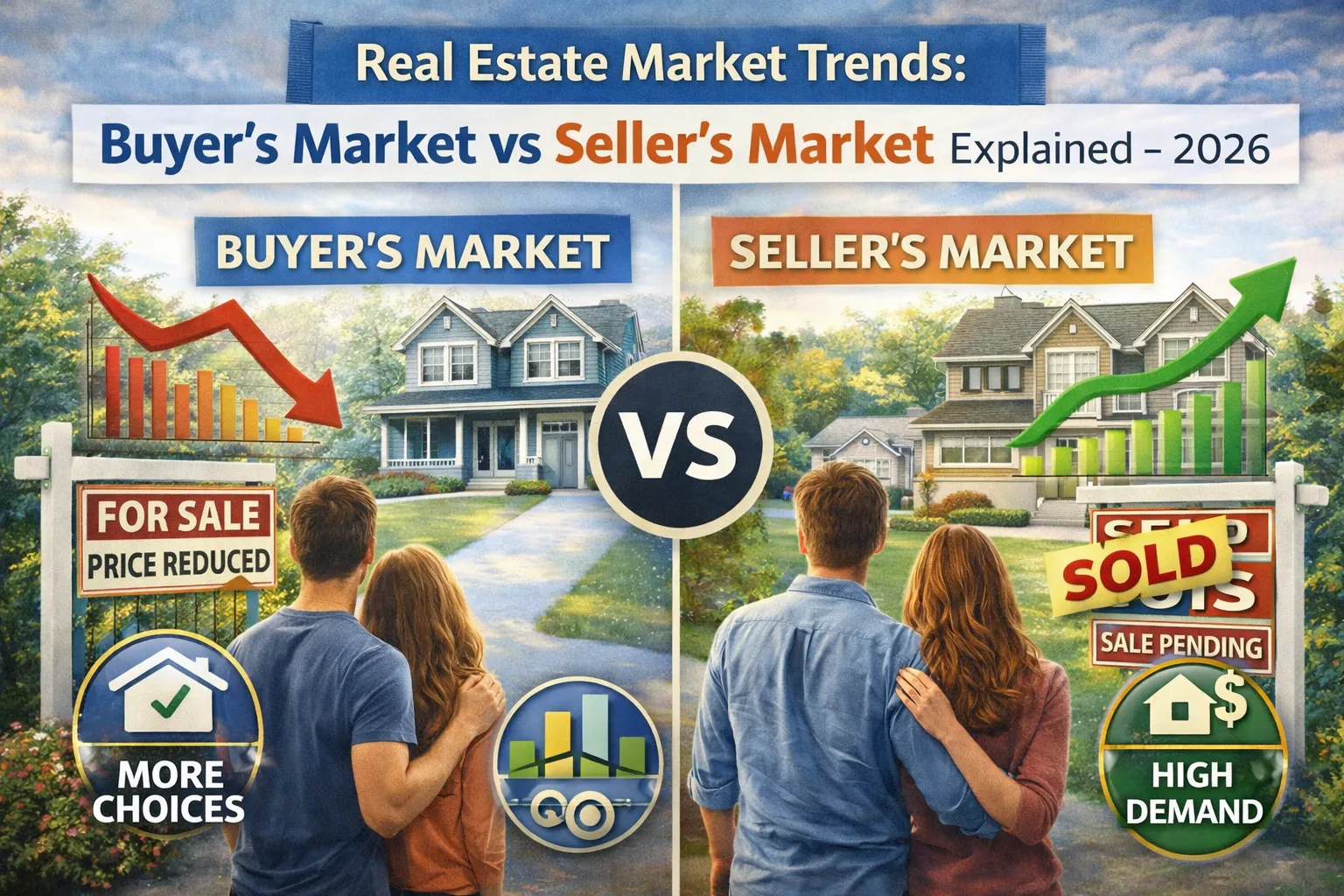
Every day in 2026, thousands of Americans open Zillow or Redfin and ask the same question: “Is this a buyer’s market or a seller’s market right now?”
The answer determines whether you should write an aggressive offer tonight or wait six months. It decides if you list your house this spring or hold until 2027. It literally controls hundreds of thousands of dollars in your family’s wealth.
Yet most people still rely on vague headlines or their cousin’s opinion from three states away.
Here is the clearest, most current explanation of buyer’s market vs seller’s market you will read in 2026 — complete with exact metrics agents and investors are using right now to make decisions in real time.
The Only Three Numbers That Actually Matter in 2026
Forget the noise. The U.S. housing market type boils down to three data points updated monthly:
- Months of Supply (or “Inventory Months”)
- Under 4 months = Seller’s market
- 4–6 months = Balanced market
- Over 6 months = Buyer’s market
- Sale-to-List Price Ratio
- Over 100% = Strong seller’s market
- 98–100% = Balanced
- Under 98% = Buyer’s market
- Median Days on Market
- Under 20 days = Hot seller’s market
- 20–45 days = Balanced
- Over 45 days = Buyer’s market
As of October 2026, the national average stands at 5.8 months of supply, 98.7% sale-to-list, and 48 days on market — technically a mild buyer’s market for the first time since 2019.
But the national number is almost useless. Real estate is hyper-local.
How the Market Looks Right Now – October 2026
Strong Seller’s Markets (under 3.5 months supply)
- Austin north suburbs, Nashville metro, Charlotte metro, Raleigh-Durham, Boise, Provo-Orem, parts of Southwest Florida
- Sale-to-list: 101–104%
- Median DOM: 9–18 days
Balanced Markets (4.5–5.5 months)
- Denver, Salt Lake City, Colorado Springs, Minneapolis-St. Paul, Madison WI
Clear Buyer’s Markets (over 7 months supply)
- San Francisco Bay Area, Seattle metro, Portland OR, Boston metro, New York City boroughs (except parts of Brooklyn), San Diego, Los Angeles, Miami-Dade, Phoenix metro, Las Vegas, Atlanta outer suburbs
- Sale-to-list: 95–97.5%
- Median DOM: 62–94 days
What Actually Happens in a True Buyer’s Market (2026 Reality)
When inventory crosses 7+ months, buyer behavior changes dramatically — and fast.
Real examples from the past 10 months:
Phoenix – 8.4 months supply (Sept 2026)
- Average seller concession: $18,500
- 42% of listings take price reductions
- Homes that close do so at 96.3% of final list price
- Buyers routinely ask for (and receive) closing costs, 1-year home warranties, and repair credits
Austin – still 3.1 months supply (Sept 2026)
- Average concession: $4,200
- Only 11% of listings reduced
- Final sale price: 101.8% of original list
That gap is worth roughly $140,000 on a $650,000 home.
Financial Impact: Buyer’s Market vs Seller’s Market in 2026 Dollars
Take an identical 2025-built 4-bed, 2,400 sq ft home in a Charlotte suburb valued at $615,000 by all three AVMs.
Seller’s Market version (March 2026 – 2.8 months supply):
- List price: $629,000
- Offers received: 14 in 8 days
- Final sale price: $648,000
- Seller concessions: $6,500 rate buydown
- Net to seller after commission: $603,000
Buyer’s Market version (October 2026 – 7.3 months supply):
- List price: $619,000 → reduced to $599,000 after 44 days
- Offers received: 2
- Final sale price: $592,000
- Seller concessions: $14,000 closing costs + $9,000 repairs
- Net to seller after commission: $534,000
Difference: $69,000 less in the seller’s pocket for waiting eight months.
Warning Signs You’re Shifting from Seller’s to Buyer’s Market
Top agents watch these five leading indicators like hawks:
- Active listings up 30%+ year-over-year in your ZIP code
- Pending sales down 15%+ year-over-year
- Price reductions appearing on 35%+ of listings (check “price improved” filter on Redfin)
- Open houses becoming quiet after once being packed
- Builders offering free 2-1 buydowns or $50k off on standing inventory
When four out of five are flashing, the shift has already happened.
How Smart Buyers Win in a Buyer’s Market (2026 Tactics)
The best buyers treat a buyer’s market like a fire sale with limited inventory of truly good homes.
Current winning strategies:
- Get fully underwritten pre-approval (not just pre-qualified) — beats 90% of competing offers
- Offer 90–95% of list with strong earnest money ($15k–$25k) and short inspection period (7–10 days)
- Ask for closing costs AND a rate buydown — sellers are saying yes in 68% of transactions over 7 months supply
- Target listings that have been active 45+ days — those sellers are exhausted and ready to deal
How Smart Sellers Survive (and Still Win) in a Buyer’s Market
You do not have to lose money just because inventory is high.
Sellers who beat the market in 2026 follow this exact playbook:
- Price at or below the lowest realistic comp from day one
- Invest $8,000–$15,000 in paint, carpet, staging, and professional photos
- Offer a 2-1 buydown or $15k flexible credit upfront in MLS
- Hold weekend open houses with aggressive marketing ($1,500–$2,500 Facebook/Instagram geo-fence ads)
- Accept the first reasonable offer that meets your bottom line — the second offer is rarely better in a buyer’s market
Data from Bright MLS (Mid-Atlantic) shows sellers who did all five netted 4.1% more than sellers who “tested the market” in Q3 2026.
Common Mistakes That Cost People Tens of Thousands
- Believing “my house is different” and overpricing by $40k
- Waiting for spring selling season when inventory peaks even higher
- Refusing to pay for a rate buydown because “rates will drop anyway”
- Pulling the home off market after 60 days instead of reducing aggressively
- Choosing the highest offer that falls apart in underwriting (happening in 28% of transactions over 8 months supply)
Expert Tips from Agents Closing Deals in Both Market Types – 2026
- Never make decisions based on national headlines. Check your specific county on HousingWire’s Local Market Tracker or Altos Research (both update weekly).
- Assumable mortgages (FHA/VA under 4%) are the nuclear weapon of 2026 buyer’s markets — search for them specifically.
- In buyer’s markets, the listing with the best photos and lowest price wins 87% of the time. Everything else is noise.
- Track “new pending sales” weekly, not just active listings. A sudden drop in pendings is the earliest warning of a cooling market.
- Work with an agent who can show you the last 12 months of absorption rate charts for your neighborhood — anyone who can’t is guessing.
Frequently Asked Questions
Q: Is 2026 a buyer’s market nationally?
A: Yes — barely. 5.8 months supply is the highest since 2019, but many Sun Belt and Midwest markets remain balanced or seller-friendly.
Q: When will it become a strong buyer’s market?
A: Most forecasts say not until inventory hits 7.5–8 months, which could happen by Q2 2027 if job growth slows and rates stay above 5.5%.
Q: Should first-time buyers wait for lower prices?
A: Waiting usually costs more in appreciation and rate differences than you save. A $500,000 home at 6.25% costs the same monthly as a $460,000 home at 7.75% — and you miss two years of equity.
Q: Are we going to see 2020-style seller’s markets again soon?
A: Not before 2029–2031. Demographic demand is strong, but 5.5 million units of missing supply from 2008–2020 have finally been rebuilt.
Q: Which cities have the strongest buyer’s markets right now?
A: San Francisco (11.4 months), Austin outer suburbs (9.8 months), Boise (9.1 months), and Phoenix (8.4 months) offer the most leverage for buyers in October 2026.
The difference between a buyer’s market and a seller’s market is not theory — it is tens of thousands of dollars in your pocket and years of financial trajectory for your family.
Understand exactly which market you’re in today, then act decisively with the strategies that match current conditions.
Because in real estate, the person who correctly identifies the market type first almost always wins biggest.
Work with a local expert who lives in the data every single day — not someone who reads headlines once a week.
Your next move depends on it.